Hydrangeas are like the spring’s pompom, cheering on the season. Blooming from spring to autumn, this flower is so beloved that it even has its own holiday! Hydrangea Day is celebrated on January 5th, which is perfect since it is a time of year when the beautiful Hydrangea ‘Endless Summer‘ is in full bloom!
If you are looking at growing your own hydrangeas at home, read the following tips and tricks on how to plant and care for them, particularly the Hydrangea ‘Endless Summer’:
Appearance
Hydrangea ‘Endless Summer’ is a deciduous shrub growing in a rounded shape. Its glossy, dark green leaves range from 10 – 20cm long, and its stunning blooms are showy mopheads nearly 20 – 25cm in diameter.
You can choose from a range of colours, depending on the alkalinity or acidity (pH) of your soil. Starke AyresAcid Loving Plant Food is a good fertiliser to help you regulate the pH levels. Shades range from deep blue to vivid lavender and from soft mauve to rose pink, depending on the .
Hydrangea ‘Endless Summer’ is compact, growing 1.5m tall and 80cm wide.
Planting
Autumn or early spring are the best times to plant Hydrangeas ‘Endless Summer’, since you want to give them time to establish a healthy root system before the blooming season begins.
Choose a sheltered planting site that receives partial shade – ideally, sun in the mornings and shade in the afternoon. Before planting, decide what colour Hydrangea ‘Endless Summer’ blossoms you want.
Dig a hole twice the width of your ‘Endless Summer’ root ball and roughly its depth. You want your plant to be just slightly higher than the level of the surrounding soil.
Begin to backfill the hole with soil. Stop halfway and pour water into the hole until it rises to the top. Once it drains away, finish filling in the rest of the soil.
If you’re planting your Hydrangea ‘Endless Summer’ plants as foundation plants, space them 2.5m apart from each other, measured from the centre of the plants. For a garden border, space them out 1m apart.
Growing conditions
‘Endless Summer’ actually enjoys partial shade to full sun and is able to bloom on both old and new growth from spring through summer or early summer to autumn, depending on the climate of your area.
Sun and shade:
‘Endless Summer’ thrives in partial shade, or roughly four hours of direct, unfiltered sunlight per day. It’s best if it receives sun in the morning and shade in the afternoon.
Soil:
‘Endless Summer’ can grow in a range of soils but needs moisture to flourish. The key thing to remember about soil is that the level of acidity or alkalinity will determine the colour – from blue to purple to pink. For a bluer shade, make sure your soil is acidic. For pinker, amend it to more alkaline, as needed. For bluer blossoms, you can adjust your soil with sulphur. If you’re more interested in bold pinks, adjust it with lime.
Watering:
You should water your ‘Endless Summer’ routinely each week, up to twice a week during the hotter months.
Fertilising:
Fertilise your ‘Endless Summer’ once in spring or summer with a specially formulated fertiliser, such as Starke Ayres’ Hydrangea Food or Acid Loving Plant Food.
Pruning:
You do not have to prune your ‘Endless Summer’, because they can bloom on both old and new growth. However, you should trim any dead, dying or diseased branches when you notice them.
Happy hydrangeas makes for a happy gardener
Be sure to follow these easy steps for happy Hydrangea ‘Endless Summer’ plants. They will keep blooming for you to enjoy! Buy your ‘Endless Summer’ hydrangeas in all the colours at Plantland.
There are few things nicer than walking in your garden, soaking up the sun, smelling all the different fragrances of the flowers and hearing the bees humming away. One specific plants comes to mind when picturing this image, and it is the lovely Lavandula dentata ‘Elegans‘.
As they dance in the wind with their long dainty stems topped with a vibrant purple, we now understand why bees absolutely love these shrubs!
Lavendula dentata ‘Elegans’
A bushy shrub with fragrant dark green leaves and dark purple flowers from spring to summer, they love to be planted in the sun where they can cope with all the shine in your garden! The Lavendula dentata ‘Elegans’ grown by Malanseuns is excellent to use for cut flowers and can be used as pot-pouri as well.
When you think of planting lavender, don’t limit its use to garden beds bedding – use the lavender as a fragrant hedge in your driveway or try it in a beautiful pot on your patio to enjoy.
What benefits would you enjoy from this delicate perennial?
Lavendula dentata ‘Elegans’ is a very versatile plant that can be used for cooking, for decorating and for aromatherapy apart from using it in your garden. We would say yes to choosing this plant for all these wonderful reasons!
Bringing the lavender fragrance indoors
Savouring the Lavendula dentata ‘Elegans’ in your food is a treat, from baking with lavender to savoury dishes or making a soft lavender ice-cream – lavender brings a floral-earthiness-minty type of flavour and aroma to food. How delicious!
If you’re not sure how to use lavender in your food, always choose to use it sparingly because its scent can be a little overwhelming, like vanilla. We suggest to rather start mixing a little bit with your dish, along with other great pairing herbs such as thyme and rosemary, and as you get used to the taste explore with different combinations. You can use freshly picked lavender or ground dry buds that you can keep as spice in your cabinet, for you to explore with in the kitchen.
Easy chicken and lavender recipe:
We found this easy and delicious chicken recipe for you to try. Thank you www.sumptuousspoonfuls.com for this recipe! Enjoy readers.
Ingredients:
1/2 tablespoon olive oil
3 – 4 chicken leg quarters (or other chicken pieces)
1/2 cup white wine
1 tablespoon honey
10 cloves of garlic, peeled and halved
Several sprigs of fresh lavender leaves
1 lemon, cut into slices, rind and seeds (mostly) removed
Seasoning of your choice, including freshly ground pepper
Instructions
Preheat oven to 200°C.
Heat an oven-proof pan over medium heat, then add the olive oil and swirl around to coat the bottom of the pan.
Fry the chicken till the skin is golden brown on both sides (not to cook the chicken, just to brown it).
Remove the chicken from the pan, drain the excess fat, add the wine and honey, and swirl around to deglaze the pan.
Arrange the chicken pieces in the pan, sprinkle with pepper and other seasoning, then sprinkle with lots of lavender leaves and add the lemon slices on top.
Set the pan in the oven and set a sheet of aluminium foil on top for 20 minutes.
Remove the foil and let cook for another 20 – 25 minutes or until the juices of the chicken run clear when poked with a knife.
Add some fragrance to your garden
Next time you visit Plantland, remember to add the Lavendula dentata ‘Elegans’ to your trolley: you will be amazed as to all the astounding things you can do with this perfect lavender.
Absolutely anyone can master patio or container gardening. These are words that will make beginner gardeners dance with joy, especially if you know nothing about gardening!
Most plants aren’t finicky about the type of pots you plant them in; you must simply remember to give them space to spread their roots.
Container or patio gardening is a benefit for everyone – those with enough land to grow a beautiful garden with pot plants placed in a shaded area as well as balcony gardening for those who have limited space but would like to create a beautiful quaint plant-filled portion.
Benefits of patio gardening:
Versatile gardening
One of the biggest reasons why patio gardening is popular is that the pot can be moved around. Just imagine placing a pot of rosemary right outside your kitchen – culinary convenience at your doorstep. When you’d like to move it, it’s as simple as picking up the pot and moving it to its new space.
Low maintenance
Plants in containers require less maintenance, as there is a smaller area to tend to attention than a garden bed. Patio gardening is great for beginners because it requires also less care and attention, as it is easy to control the quality of the soil in the pot, which helps to control disease and insect pests.
Be creative
Container planting allows for maximum creativity. There are all sorts of pots you can buy, with different colours, patterns and textures for you to choose from. If you really feel creative, you could take it a step further and paint an old terracotta pot to look like a face and then plant a carex so that it has ‘hair’.
Patio gardening does require a little work
It is true that a patio garden is much easier to care for than a garden, but it requires more watering as the plants dry out faster. Luckily, Starke Ayres new Hydrocache water-retaining gel offers a great solution to get around this problem.
Also remember to fertilise your planted pots for them to get all the nutrients they need to grow strong and healthy.
Get started with patio gardening
First, you will need to assess the amount of space you have for the plants you plan to grow. This will help you visualise your garden and make your trip to a Plantland garden Centre much easier.
Also consider choosing plants that pair well together; this will benefit plant growth as time goes by. We say it is best to pair plants with similar needs to make the care process so much easier– pack them together!
How many times have you walked past a house in a lovely neighbourhood, and all you could smell was the aroma of the food being cooked that almost makes you feel like asking for a seat at that dinner table. It is as if the herbs and spices they’ve used are calling you, and your stomach begins to growl.
We don’t know about you, but we always aim to fill our homes with the comforting smell of food, and we also know for sure that fresh herbs add extra love and delight to any meal.
Benefits of growing your own herbs
Fresher tastes
Fresh herbs in your garden mean meals packed with much more flavour. There is nothing that can beat the fresh taste in your infused water or the stew you plan to make for Sunday lunch.
Adds variety to your meals
Having a broad variety of fresh herbs allows you to experiment with different flavours. When you are looking at doing a leg of lamb, the best herbs would be thyme, rosemary and even a little basil. We bet you can smell it already!
Antioxidants
Herbs are a good option when looking at living a healthier lifestyle. Most herbs are packed with antioxidants that help to clean your liver.
Relieves stress
Tending to your own herb garden will help you get rid of the stress built up during the week, being one with nature and learning about the benefits the different herbs have to offer.
Start Simple
Growing herbs from Starke Ayres seeds is good for intermediate gardeners who know a little more about sowing seeds and the requirements, and there is the wide variety on offer by Starke Ayres. There is also an option to choose from Plantland’s seedling varieties, which enables you to plant a seedling that has gone through all the growing pains and is ready for you to enjoy. Herb seedlings are good to start off with if you are a beginner gardener.
Choosing the perfect pot
It helps to know where you want to plant your herbs; by your kitchen windowsill or in pots outside your kitchen, or wherever would work best for your needs and setting. Once you have the perfect spot for your herbs, you will need to pick the perfect pot. We absolutely love the Tuscan style a terracotta pit gives, or if you are more a herb-crate type of gardener, Plantland has all the styles you could dream of! If you are creative, you could always create or paint your own pots. There are endless possibilities.
Introduce herbs to your everyday lifestyle
Whether you are a beginner herb lover or an expert herb gardener, we encourage you to explore with herbs. Use them in your teas or when you cook, and you will have a whole new culinary world to escape to.
When you’re ready to buy herb plants, check Plantland’s online store where you can shop for your favourite herbs from convenience of your own home.
It’s that time of the year again where the green industry plays an important role in reminding people about the importance of planting trees.
Arbour Week has been celebrated since 1800, founded by two lovers of nature, husband and wife team Julius and Carrie Sterling Morton. They were distressed by the lack of trees in Nebraska and quickly planted trees, shrubs and flowers in their own garden to start out with. Soon the trend followed.
“Trees were needed as windbreaks to keep soil in place, for fuel and for building materials, as well as for shade from the hot sun,” says daff.gov.za
Plant a tree
It is the year 2021, and we are still encouraged to plant trees for reasons that will remain pertinent forever. It is said that you do not plant a tree for yourself to enjoy, but for the enjoyment of future generations. Therefore, it is important to make sure that we have trees standing and providing us with shade for generations to come.
Trees are important to us for the following reasons:
Trees help to hold soil in place and prevent soil erosion.
Trees are an important habitat for wildlife; some animals spend their entire life living in trees and others depend on the forest for survival.
Trees feed us – just think of all the nutritious fruit and nuts we pick from trees.
Trees help increase property value by 5% ,or even higher depending on the size of the tree.
Trees help with saving energy by providing shade in summer and blocking strong winds in winter, therefore saving us energy we spend trying to cool and heat our spaces.
Trees help reduce loud noises in urban areas when planted strategically.
Some trees provide medicine for our use, such as tea tree and moringa trees.
The list of benefits from trees is much longer than these 10 point, such as how they help to regulate local water cycles by holding the water, therefore preventing flooding and maintaining water vapour in the air!
How to plant a tree
Plantland has a wide selection of trees available to choose from. You can choose indigenous trees or deciduous trees, flowering or evergreen. Just make sure you choose a tree you will enjoy looking at for years to come.
Tree planting procedure:
Dig a hole twice the height and width of the container of the tree. Fill the hole with water.
Mix the soil with a nutritious soil (like Malanseuns Compost) and add some bonemeal to the mixture to ensure healthy root growth.
Remove the tree from all packaging and place it in the hole, then fill up with soil to the top of the tree roots.
Press down firmly to ensure the tree is stable. Build a dam around the hole, to make sure the water will drain to the roots when watering.
Water your tree thoroughly twice a week until the tree can sustain itself.
Fertilise with 2:3:2 fertiliser when needed.
Trees are good.
Planting trees, even just one or two, can make a huge difference. Trees are our lifeline to cleaner air and a healthier environment as trees improve air quality by producing oxygen. We need trees now more than ever! Teaching our children from little to appreciate trees will do the world good. View our wide range of trees on plantland.co.za or in store
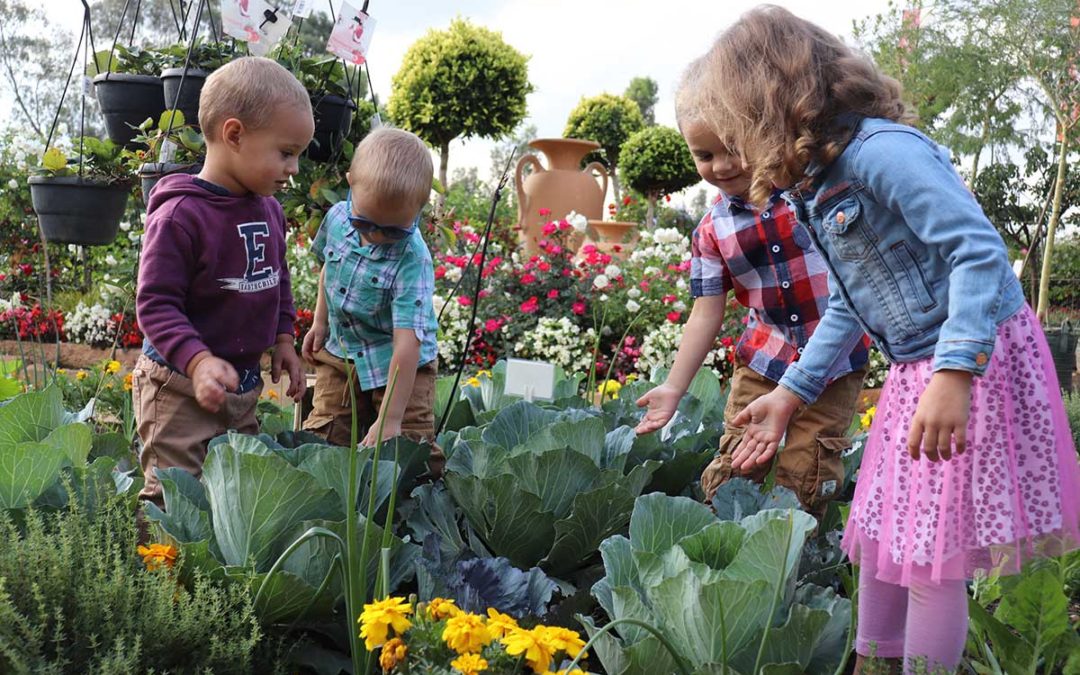
Imagine trying to teach a child about the laws of nature and how the ecosystem is one big cycle of giving, and then you’re suddenly inspired to grow some plants that attract insects. This would be great! These insects will help pollinate plants, and the child can actually see the entire process happening in many ways, bringing them closer to nature and how it works – all right in front of their eyes.
Teach them to enjoy gardening
When you plan and tend to your garden with your children, they will grow to understand that they exist as one with every living, breathing species they interact with, and plants are a big part of the process. For this we should be thankful for plants. This is a much better and more affordable way of educating our children than trying to educate them with toys.
Gardening from a young age teaches our children a sense of responsibility, caring for their first plant and tending to its needs. They will love the feeling of accomplishment when their plants start flowering, and they can show it off to their friends.
Let’s teach our children to garden, to grow their own food and to appreciate everything plants do for us and help them by bringing them closer to nature!
Urban structures turn green
Many of us live in urban areas with tall cement buildings, and we constantly find ourselves seeking out a little nature to surround and comfort us. Imagine the benefits if we all planted a tree or filled our homes and balconies with at least two plants – how much more hospitable we would find our concrete jungle as the plants softened our hard buildings and purified the air we breathe. Our productivity would increase as plants helped us to relax, making it easier to enjoy the space we live in.
It has also been said that patients in hospitals that integrate plants as part of their furnishing recover quicker. Yay for plants!
Enjoy being closer to nature
Just think of how relaxed you feel when you’re out with friends in nature, camping or taking a walk in a nature reserve. Or when you fill your home with indoor plants, or while you are outside gardening – you naturally feel at one with yourself! You interact with nature, which is alive and healthy, your spirit gets recharged because humans are nature themselves.
Once we have a mutual respect for plants, we will understand that they are here to assist us. We will go out into the wild to be surrounded by tall trees, we will listen to the gentle waves of the ocean, we will admire the sun shimmering on us, we will hike and camp more often. Our plates will be filled with more vegetables, and we will even create mini natural spaces in our offices. We will start noticing that the places we visit, such as restaurants, are bringing in more natural greenery for our goodness. We will keep our plants alive for sure!
We all need to get closer to nature
‘Eco-therapy’ is a great word to describe the effects of nature on our mental state, because we definitely experience a feeling of higher life satisfaction when surrounded by nature. We need to realise that we shouldn’t take nature for granted just because we experience it for free when we step outside every day. We all need to learn to love and respect nature, and to impart this love and respect to our children too.
Visit Plantland for more information, tips and ideas.
The title of this article reminds us of a short children’s book by Lizzy Rockwell. The first few lines of the book say, ‘I am a plant eater. Plants reach out for the sun; they grow in the ground. I eat different parts from different plants, sometimes I eat the leaves, other times the roots, bulbs, stems and flowers too.’ We love this little story because it teaches children, while they are still young, that homegrown food that grows from the ground is nutritious.
We know now that eating is learnt behaviour; children watch us like we did our parents. Let’s go back a million years, to when humans were learning to understand the plants around them.
The history of plant food and homegrown food
According to scienceabc.com, ‘Our early ancestors were far more connected to the earth than most modern humans, and had to have a deep understanding of the plants and ecosystems where they lived. Their learned behaviour came from observing the generations that came before and absorbing that knowledge.’
‘Once humans became largely agricultural-based and narrowed their diets down to staple foods, much of the knowledge of wild plants was lost, or faded, but dietary traditions and regional standards persisted, based on what could best be cultivated in the area. Similarly, during the age of exploration, many legendary explorers and their crews became sick and died, often after eating the native plants. Without the regional knowledge or a local guide, they lacked the ‘learned behaviour’ that would keep them safe in that area.”
Store-bought veggies or homegrown food
Now that we have learnt this eating behaviour from our ancestors, we know which plants are safe to eat and which aren’t. The next step is to speak of growing our own food. A sustainable garden has become very trendy over the past few years, and even some well-known celebrities have shown that following a plant-based diet can be good for your well-being.
Yes, it is easier and more convenient to buy our veggies and fruits from our local stores, but homegrown food produces much tastier food that stays fresher for longer, and can be pesticide and chemical free (if you make an effort to make it so). Growing your own food is organic, healthy and even a solution to health, environmental and economic problems.
So the next time you buy your fresh produce, think of all the fun you could have had enjoying the outdoors and growing your own.
Veggies to plant
Crop pairing
A fabulous veggie gardening trick is to grow compatible plants together. You can think of this as growing your garden in layers, with plants growing upwards, ground dwellers and also climbers. Great pairings include:
Corn, beans and squashes;
Tomatoes, basil and onions;
Leafy lettuce, peas and brassicas (broccoli, cabbage).
Cut-and-regrow vegetables
Some vegetables and herbs regrow after you harvest them, producing new leaves in place of the ones you cut off. These plants include well-known favourites such as beetroot, coriander, kale, mustard, parsley, rocket, basil and spinach.
Rotating planting
This concept involves the rotation of crops in a space, and replanting new seasonal crops. This rotation method helps you to make the same garden space productive all year round, filled with fresh vegetables each season.
Planting and harvesting homegrown food
Since plants are so generous, we could learn from them to give freely by also planting plants that other living creatures can enjoy. If we follow this concept we will help to keep the circle of life going!
For more info and assistance on vegetables and fruits visit Plantland
Gardening is biology, revolving around the biological processes of growth and life. For millions of years, plants have thrived and grown successfully with no human intervention.
Chemical pest control and plant nutrition have become the norm over the past 80 years, though, with many negative side effects recently emerging. The good news is that new natural innovations, offering a long-term holistic alternative, are now emerging – ‘biologicals’ for biological gardening.
A biological gardening approach centres around nature, embracing the synergistic relationships that occur naturally to ensure survival and sustainability. As gardeners we have been taught to view bacteria as germs, fungi as diseases, and insects and weeds as pests. However, the scientific truth is that many of these critters are beneficial, even essential, to healthy plant growth and development. When there is an excess of one pest species it is often an indication that the natural balance has been disturbed and an indication of vulnerability.
Natural biological control takes place continuously, in its own unique way, within every ecosystem. Using a garden as an example, biological pest control would include everything from birds feeding on grubs to owls catching rats, to ladybirds keeping aphids under control, or parasitic wasps laying their eggs on caterpillars. Even competitor plants such as alien invasives influence the ecosystem of a garden.
Finally, gardeners need to be aware that there are good pathogens – beneficial bacteria, fungi and viruses that feed on microbes and insects. There are also bacteria that are good for the soil, as probiotics are good for your stomach.
Biological products contain the naturally occurring enemies of crop pests and diseases, as well as organisms that facilitate improved root growth and nutrient uptake. These living organisms may be fungi, bacteria or viruses, in environmentally friendly and easy-to-use formulations, excellent for biological gardening.
Although perceived as a relatively new science, this technology dates back to the late 19th century, but has experienced a re-emergence with the decreasing faith in chemical agriculture. The process of identifying, screening, isolating, testing and mass producing microbes can take decades and in order for biological products to be sold commercially, they need to adhere to the same stringent controls as synthetic products in terms of efficacy and application.
Several strains of fungi and bacteria have been identified to be effective in the control and management of pests and diseases. Each has a unique mode-ofaction. For example, the fungal spores of Beauveria bassiana attach and penetrate through the ‘skin’ of whitefly, spider mite and various other insect pests when contact is made. The fungus grows and multiplies inside the insect, ultimately resulting in death. Similarly, beneficial bacteria Bacillus amyloliquefaciens colonises plant surfaces, occupying space at potential infection sites, utilising nutrient sources and making it difficult for pathogens such as powdery mildew to get established.
Biopesticides are not a ‘soft option’, but offer highly effective pest-management solutions. Due to their natural presence and relative host specificity they are safe for the environment, non-toxic to non-target organisms like bees, beneficial insects, pets and, most importantly, children. In addition, most bio-pesticides are residue free and can be applied to edible crops right up to harvest. They also act in a way that is unique when compared to their chemical counterparts. This makes them ideal for use in rotation with synthetic chemistry to prevent and manage pest resistance – a process whereby frequent use of the same chemistry results in a pest organism no longer being susceptible to its effect.
What does all this mean for biological gardening?
The goal of sustainable biological gardening is to grow healthy plants, in a healthy environment with minimal impact on the environment. Biopesticides offer natural, non-chemical alternatives. These may not be as immediate and as impactful as a synthetic pesticide, because they take a little longer to take effect, but they are just as effective as their chemical counterparts and should be the first option in your garden’s pest management program.
There are always those gardening tasks we cannot get away from. A little bit of work will be greatly rewarded when the family pops around for the festive season.
Prune rambling roses, feed, water well and add a layer of mulch. Stake dahlias as they grow and keep disbudding them by removing the side buds to encourage large flowers. Cut back chrysanthemums to ensure bushier growth and lots of flowering stems in autumn. Mulch with fresh compost and water well afterwards. Keep spraying deciduous fruit trees against fruit fly.
To avoid blight on tomatoes and mildew on cucumbers, squashes and pumpkins, water them early in the morning to give the leaves time to dry off before nightfall. Give citrus trees their mid-season feed of granular fertiliser. Spread evenly over the drip line 20 – 30cm away from the stem. Mulch and water well.
Planting seed potatoes in December and January will produce a harvest in April and May for storing and eating during winter. Weed the garden. After weeding place a layer of organic mulch over every last inch of soil. Mulching not only saves water and your time when you’re desperately busy with other tasks, but will also provide a professional and well cared for look and will display existing plants to their best advantage.
Add swathes of gauras, angelonias, cupheas, lavender, Plectranthus ‘Mona Lavender’, bacopas, perennial verbena and pentas – none of these need excessive pampering or watering!
Large vegetables (tomatoes, brinjals, squashes etc.) should be watered deeply twice a week while seedlings and shallow-rooted veggies (Swiss chard, lettuce etc.) need less water more frequently, even daily in hot December temperatures. Support fruit-bearing tomato stems to prevent the stems from breaking or bending. Use soft ties and loop the tie around the stake and the stem in a figure of eight. Fertilise fruiting crops when they start to flower and leafy vegetables after picking.
Remove weeds that compete for water. Renew mulch if necessary.
5 minutes to spare
Check quick-bearing veggies (beans, marrows etc.) each day and harvest so that fruit doesn’t grow too big or too tough.
10 minutes to spare
Start sowing cool-season crops (cabbage, cauliflower etc.) in seed trays. Keep them out of direct sun but in good light and make sure the soil is consistently moist during germination.
Good idea…
Grow loose-leaf lettuce in the shade of taller plants like runner beans, tomatoes and brinjals.
Our Team is ready to answer any questions or concerns that you may have. Feel free to get in touch!
Office Hours: 8:00am – 16:00pm
If we are not available then email us and we will get back to you as soon as possible. hello@tanyavisser.com